How to read a birth chart: a plain guide for complete beginners
Planets, signs, houses, the Rising sign and aspects: the five things you need to read your own birth chart, explained step by step and without jargon.
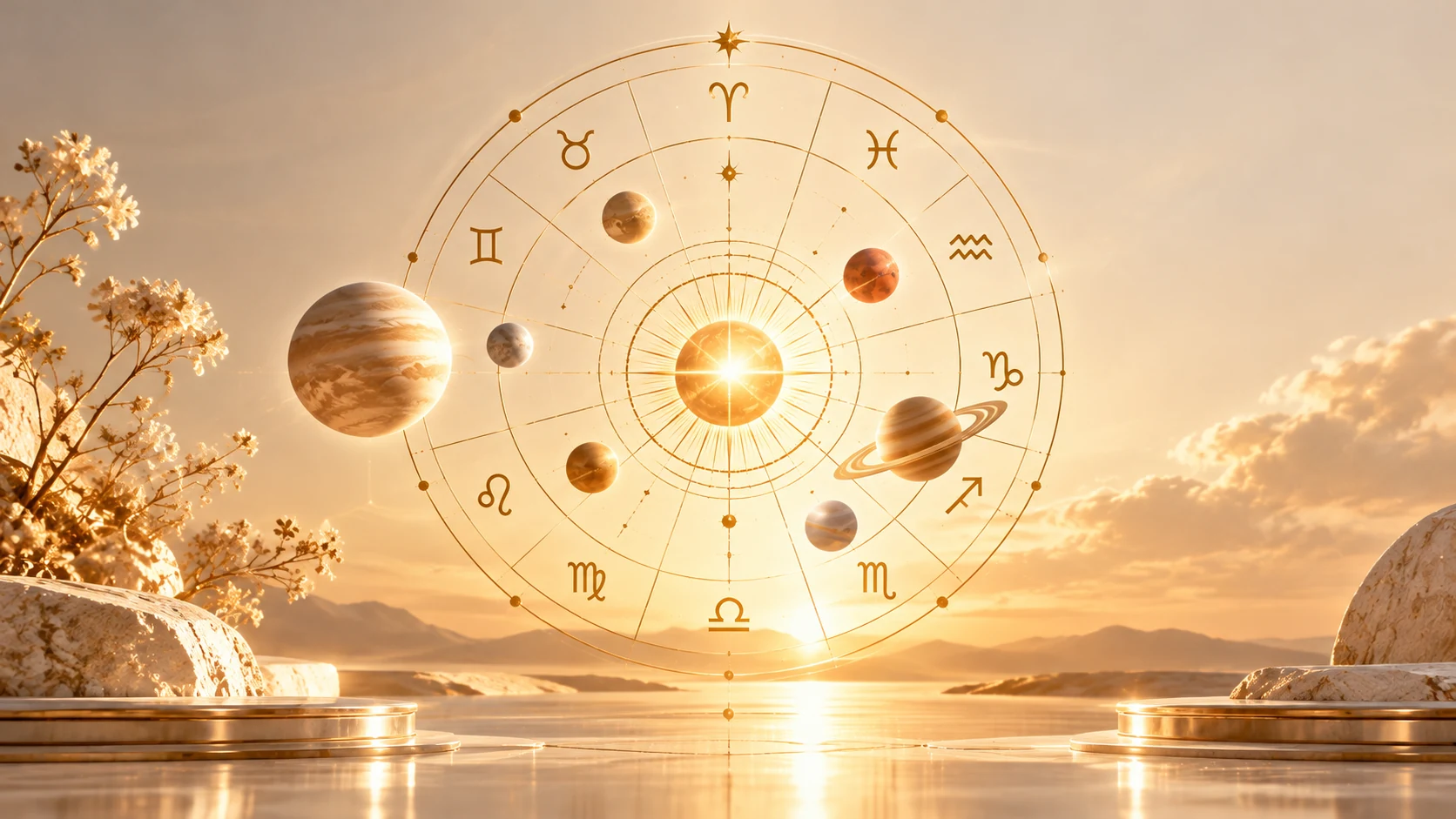
Learning how to read a birth chart looks harder than it is. The circle full of symbols is really just a map of the sky at the minute you were born, seen from the place you were born. Once you know the four building blocks (planets, signs, houses and aspects) you can read the basics of any chart, starting with your own.
This guide walks through them in the order an astrologer would, with no jargon you have not been given first. To follow along, draw your free birth chart in another tab.
What a birth chart actually is
A birth chart, also called a natal chart, is a diagram of where the Sun, the Moon and the planets were in the zodiac at your exact time and place of birth. In astronomy terms, it is a snapshot of the sky projected onto the ecliptic, the path the Sun appears to follow across the year. The general idea of the horoscope chart goes back more than two thousand years.
You need three things to draw one:
- Date of birth
- Time of birth, as exact as you can find it (birth certificates, hospital records and parents' memories all help)
- Place of birth, because the sky looks different from different places
Without the time, you can still see where the planets were in the signs, but not the houses or the Rising sign. Those depend on the minute.
Step 1: The planets (what)
Each planet stands for a part of you, a different kind of drive.
| Planet | What it describes |
|---|---|
| Sun ☉ | your core identity and what gives you life |
| Moon ☽ | your emotions, needs and what makes you feel safe |
| Mercury ☿ | how you think, learn and communicate |
| Venus ♀ | what you love, value and find beautiful |
| Mars ♂ | how you act, fight and go after what you want |
| Jupiter ♃ | where you grow, expand and find luck |
| Saturn ♄ | where you meet limits, responsibility and mastery |
| where you break rules and need freedom | |
| Neptune ♆ | where you dream, idealise and dissolve boundaries |
| Pluto ♇ | where you transform, sometimes through crisis |
Start with the "big three": your Sun, your Moon and your Rising sign. Together they give a surprisingly accurate first sketch.
Step 2: The signs (how)
The twelve zodiac signs describe how each planet expresses itself. A Mars in Aries acts quickly and directly; a Mars in Libra acts after weighing both sides. Same drive, different style.
Each sign belongs to an element:
- Fire (Aries, Leo, Sagittarius): energy, enthusiasm, action
- Earth (Taurus, Virgo, Capricorn): practicality, patience, the physical world
- Air (Gemini, Libra, Aquarius): ideas, communication, connection
- Water (Cancer, Scorpio, Pisces): feeling, intuition, depth
A quick trick: count how many of your planets fall in each element. A chart heavy in one element and light in another tells you a lot about where you are at home and where you have to work harder.
Step 3: The houses (where)
The chart is divided into twelve houses, like slices of a pie. Each house is an area of life, and a planet in a house shows where that drive plays out.
- Self, body, first impressions
- Money, possessions, self-worth
- Communication, siblings, the local world
- Home, family, roots
- Creativity, romance, children, play
- Work routines, health, daily habits
- Partnerships, marriage, open enemies
- Shared resources, intimacy, transformation
- Travel, belief, higher learning
- Career, reputation, public life
- Friends, groups, hopes for the future
- The hidden, rest, retreat, the unconscious
So Venus in the 10th house often shows someone whose career involves beauty, diplomacy or people; Venus in the 4th, someone who invests their love in home and family.
Step 4: The Rising sign and the angles
The Ascendant, or Rising sign, is the sign that was rising on the eastern horizon at your birth. It marks the start of the 1st house and colours how you come across, how you start things, even your physical style. It changes roughly every two hours, which is why the birth time matters so much. Wikipedia's page on the Ascendant has the astronomy behind it.
Three other angles complete the cross:
- Descendant (opposite the Ascendant): what you look for in partners
- Midheaven, MC (top of the chart): your public direction and career
- IC (bottom of the chart): your roots and private self
Step 5: The aspects (how it all connects)
Aspects are the angles between planets, drawn as lines across the middle of the chart. They show which parts of you cooperate and which pull against each other.
| Aspect | Angle | Feels like |
|---|---|---|
| Conjunction | 0° | two drives fused together |
| Sextile | 60° | an easy opportunity, if you use it |
| Square | 90° | friction that pushes you to act |
| Trine | 120° | natural talent, ease |
| Opposition | 180° | a tension you learn to balance |
Do not fear squares and oppositions. They are where most of the drive in a chart comes from. Charts full of trines can be gifted and strangely unmotivated.
Putting it together: a short example
Take a chart with the Sun in Capricorn in the 10th house, the Moon in Cancer in the 4th, and Leo Rising.
- Sun in Capricorn, 10th house: identity built through work, ambition and long-term achievement.
- Moon in Cancer, 4th house: a deep need for home and family, and a softer private self than people expect.
- Leo Rising: comes across warm, confident and visible.
- Sun opposite Moon: a lifelong balancing act between career and home.
Four lines, and you already have a recognisable person. That is how reading a chart works: one layer at a time, always asking what, how and where.
Common beginner mistakes
- Reading one placement in isolation. No single planet tells the whole story.
- Ignoring the houses. Signs say how, houses say where, and "where" is often the useful part.
- Guessing the birth time. A wrong time can change the Rising sign and every house.
- Treating it as fate. A chart describes tendencies and timing, not a script.
Frequently asked questions
Can I read my birth chart without a birth time?
Partly. The planets' signs and most aspects will be right, but the houses, the Rising sign and the Moon's exact degree depend on the time. If you do not know it, read the chart for signs and aspects and treat the houses as unknown.
What are the big three in astrology?
Your Sun sign, your Moon sign and your Rising sign. They describe your core identity, your emotional needs and the way you meet the world.
Which house system should I use?
Placidus is the most common in modern Western astrology and is the default in our free chart, which also lets you switch to Whole Sign houses, a popular alternative. Start with one system and stay with it while you learn.
Your next step
Draw your birth chart for free: it shows every planet, the Rising sign and all twelve houses, computed for your exact time and place. Then try the other free tools to see your chart in motion. And when you want someone to read the whole picture with you, the Soul Blueprint is Mr. Tanker's full interpretation of your chart, line by line.