Home / Blog / Astrology & Self-Discovery
Moon Sign Meaning: What Your Moon Sign Reveals About Your Emotional World, Love Style, and Inner Self
Discover what your Moon sign means, how to find yours, and what astrology says about your emotions, love life, inner self, and compatibility.
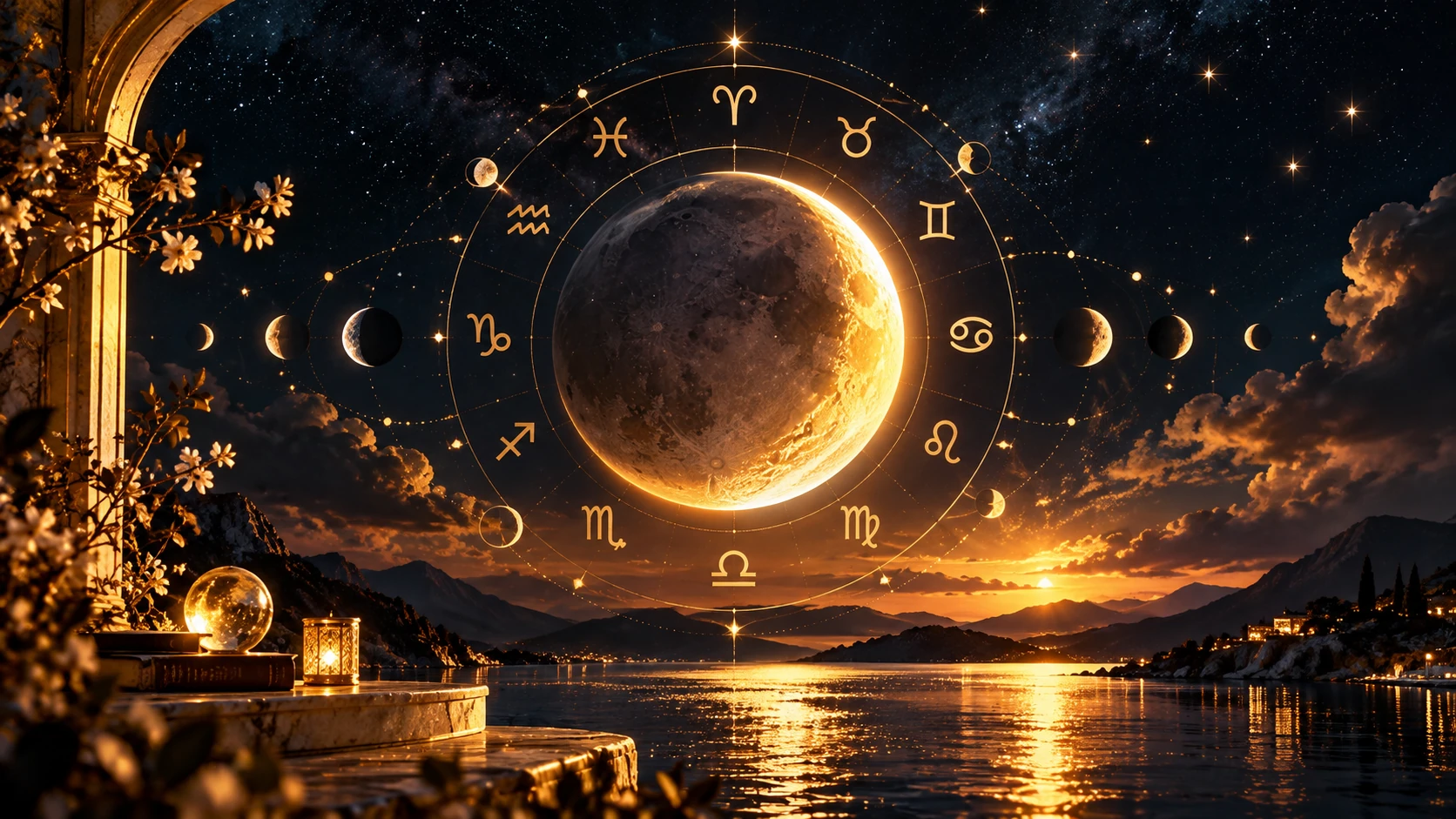
Have you ever wondered why the way you feel inside seems different from the person you show to the world? Why do some people need time alone to process their emotions, while others need to talk, connect, or take immediate action?
In astrology, your Moon sign is associated with your emotional world, instinctive reactions, sense of security, and private self. While your Sun sign is traditionally connected with your core identity, your Moon sign offers another symbolic perspective on how you experience feelings, seek comfort, and build emotional connections.
Understanding your Moon sign can be an invitation to explore your inner patterns, recognize your emotional needs, and reflect on the way you approach relationships.
But what exactly is a Moon sign? How do you find yours? And what does each of the 12 Moon signs mean in love, everyday life, and personal growth?
In this guide, I’ll walk you through the meaning of Moon signs, how to find yours in a birth chart, and how astrologers traditionally interpret all 12 zodiac placements. My aim is to make the subject accessible without presenting astrology as a scientific personality test or a fixed description of who you are.
In This Guide
- What Is a Moon Sign in Astrology?
- Moon Sign vs. Sun Sign vs. Rising Sign
- How to Find Your Moon Sign
- The 12 Moon Signs and Their Meanings
- Moon in Aries
- Moon in Taurus
- Moon in Gemini
- Moon in Cancer
- Moon in Leo
- Moon in Virgo
- Moon in Libra
- Moon in Scorpio
- Moon in Sagittarius
- Moon in Capricorn
- Moon in Aquarius
- Moon in Pisces
- The Four Elements of Moon Signs
- Moon Sign Compatibility
- How to Use Your Moon Sign for Self-Reflection
- Moon Sign vs. Moon Phase
- Can Your Moon Sign Change?
- What If Your Moon Sign Doesn't Feel Like You?
- Frequently Asked Questions
- Final Thoughts
- Sources & Further Reading
- Editorial Disclaimer
What Is a Moon Sign in Astrology?
Your Moon sign is the zodiac sign that the Moon occupied at the time of your birth, according to the astrological system used to calculate your natal chart.
In traditional Western astrology, the Moon symbolizes the more private and instinctive aspects of the self. Astrologers associate it with emotional needs, familiar habits, memories, comfort, and the way a person responds to situations that feel personal.
Think of your astrological chart as a symbolic map with different layers. Your Sun sign represents one layer of that map, your Rising sign represents another, and your Moon sign adds a perspective focused on your inner experience.
For example, someone with a confident Leo Sun might appear outgoing and expressive. If their Moon is in Capricorn, an astrologer might interpret their emotional style as more private, cautious, or practical than their outward personality suggests.
This combination does not mean the person is secretly a particular type of person. Rather, it illustrates how astrologers use different placements to explore possible contrasts between self-expression and emotional needs.
What Does Your Moon Sign Represent?
Within the language of astrology, your Moon sign is commonly associated with:
- Emotional needs: What may help you feel understood, comfortable, and supported.
- Instinctive reactions: Your first emotional response to uncertainty, conflict, or change.
- Comfort and security: The environments, routines, and relationships in which you feel at ease.
- Love and intimacy: How you might seek affection, closeness, reassurance, and trust.
- Private self: The feelings, habits, and preferences you may express more freely in familiar surroundings.
These are traditional astrological interpretations, not scientifically established descriptions of your personality. You can use them as prompts for self-reflection without assuming that a zodiac placement defines who you are.
Moon Sign vs. Sun Sign vs. Rising Sign
Your Sun, Moon, and Rising signs are often called the “Big Three” in Western astrology. Each is traditionally interpreted through a different lens.
| Astrological placement | Traditional meaning | Questions it explores |
|---|---|---|
| Sun sign | Core identity, purpose, self-expression | What feels important to me? |
| Moon sign | Emotional needs, comfort, instinct | What helps me feel safe and understood? |
| Rising sign | First impressions, outward approach, presentation | How do I approach new situations? |
Your Sun Sign: Your Core Identity
Your Sun sign is the zodiac sign occupied by the Sun at the time of your birth, according to the chosen zodiac system. In astrology, the Sun is associated with identity, vitality, personal direction, and self-expression.
When someone asks, “What is your zodiac sign?” they are usually asking for your Sun sign.
Your Moon Sign: Your Inner Emotional World
Your Moon sign focuses on a different set of symbolic themes: comfort, feelings, instinctive reactions, and emotional connection.
For example, someone whose Sun and Moon are both in air signs might be described by an astrologer as valuing communication in both self-expression and emotional processing. Someone with a Taurus Sun and Gemini Moon might be interpreted as combining a preference for stability with curiosity and a need for mental stimulation.
These combinations are symbolic interpretations rather than fixed personality formulas.
Your Rising Sign: Your Approach to the World
Your Rising sign, also called the Ascendant, is the zodiac sign appearing on the eastern horizon at the time and place of your birth. Astrologers associate it with first impressions, outward behavior, and the way a person approaches unfamiliar environments.
Your Rising sign depends strongly on your birth time and location because the horizon changes as Earth rotates.
Why do all three matter in astrology? Astrologers generally interpret placements as parts of a larger chart rather than treating one sign as a complete explanation of a person. Your Moon sign can offer a different perspective from your Sun or Rising sign, but it does not replace either one.
How to Find Your Moon Sign
Finding your Moon sign requires your birth information and a calculation of the Moon’s position at the relevant moment.
Step 1: Find Your Date of Birth
Start with your full date of birth, including the day, month, and year. Your birth date narrows down the Moon’s possible zodiac position. However, it may not be enough to determine your sign with certainty.
Step 2: Find Your Exact Birth Time
Your birth time is particularly useful if the Moon changed zodiac signs on your birthday. The Moon moves relatively quickly across the zodiac, so people born on the same calendar date can sometimes have different Moon signs.
If your recorded birth time is uncertain, check whether the available birth information is sufficient to distinguish between the possible signs.
Step 3: Enter Your Birthplace
Your birthplace helps a birth chart calculator interpret the local birth time correctly, including the relevant time zone and historical daylight-saving rules. Location is also essential for calculating other chart features, including your Rising sign and astrological houses.
Step 4: Use a Birth Chart Calculator
Enter your birth date, birth time, and birthplace into a reliable natal chart calculator. Look for the planetary placements section and identify the Moon symbol or the entry labeled “Moon.” The zodiac sign listed next to the Moon is your Moon sign in that calculation.
For example, Moon in Aries means your Moon sign is Aries; Moon in Cancer means your Moon sign is Cancer; and Moon in Sagittarius means your Moon sign is Sagittarius.
If you are comparing results from different calculators, check which zodiac system each one uses.
Step 5: Check the Zodiac System
Western astrology commonly uses the tropical zodiac. Vedic astrology commonly uses the sidereal zodiac. Because these systems define zodiac positions differently, the same birth information can produce different sign labels.
Neither system should automatically be treated as interchangeable with the other. When reading a Moon sign interpretation, make sure you know which astrological tradition it follows.
What If You Don’t Know Your Birth Time?
You may still be able to determine your Moon sign without an exact birth time. If the Moon remained within the same zodiac sign throughout your birth date in your chosen system, a date-based calculation may be sufficient to identify the sign. If the Moon crossed into another sign that day, however, the exact time may be necessary.
You can look for a birth record, ask a family member, or consult an appropriate official record if one is available. Avoid assuming a specific birth time simply to complete a chart.
Remember: An uncertain birth time should lead to an uncertain result, not a made-up answer.
The 12 Moon Signs and Their Meanings
Each zodiac sign has a traditional set of themes in astrology. When the Moon is placed in a sign, astrologers interpret those themes through the lens of emotions, comfort, and close relationships.
The descriptions below are intended as a guide to astrological symbolism. They are not psychological assessments, and you may identify with some themes more than others.
1. Moon in Aries: The Independent Emotional Spirit
Aries is a fire sign associated with action, initiative, courage, and independence. In traditional astrology, an Aries Moon is often interpreted as an energetic and direct emotional style. Feelings may be experienced as immediate signals to act, speak, solve a problem, or establish independence.
Emotional needs. A person with an Aries Moon might identify with needing freedom, movement, honesty, and room to make their own decisions. Waiting indefinitely or feeling unable to take action may be frustrating. Direct communication can feel more comfortable than guessing what another person is thinking.
Aries Moon in love. This placement is traditionally associated with enthusiasm, spontaneity, and a preference for clarity. An Aries Moon interpretation may emphasize the importance of maintaining individuality while building intimacy. A relationship can be meaningful without requiring either person to give up their independence.
Potential challenges. Quick reactions can sometimes make it difficult to pause before responding. Frustration may be expressed before the underlying feeling has been fully understood.
A reflection question: When you feel upset, do you give yourself enough time to understand the emotion before deciding what to do?
2. Moon in Taurus: The Search for Emotional Security
Taurus is an earth sign traditionally associated with stability, patience, reliability, and sensory comfort. A Taurus Moon is often interpreted as valuing consistency and familiar surroundings. Predictability may offer a sense of emotional ease, while sudden changes can require extra adjustment.
Emotional needs. This placement is associated with comfort, dependability, routine, and tangible expressions of care. A peaceful environment, shared meals, physical affection, or spending time in nature may serve as examples of the kinds of comfort associated with Taurus symbolism.
Taurus Moon in love. Taurus Moon interpretations often emphasize loyalty, steady affection, and relationships built over time. Small, consistent gestures can be more meaningful than dramatic declarations. Trust may be associated with knowing that someone will follow through on their words.
Potential challenges. A strong preference for stability can sometimes make change feel unnecessarily threatening. Holding on to familiar situations may also become difficult when circumstances have genuinely changed.
A reflection question: Does your desire for security help you build a stable life, or sometimes prevent you from exploring something that matters to you?
3. Moon in Gemini: The Curious Emotional Mind
Gemini is an air sign associated with communication, curiosity, adaptability, and the exchange of ideas. A Gemini Moon is traditionally interpreted as approaching feelings through thought, language, and exploration. Talking about an experience or finding the right words for it may be an important part of processing emotions.
Emotional needs. Mental stimulation, open conversation, variety, and the freedom to ask questions are common themes. A person drawn to Gemini Moon symbolism may appreciate being able to discuss difficult subjects without feeling that every conversation has to reach an immediate conclusion.
Gemini Moon in love. Communication may be a central theme in how this placement is interpreted in relationships. Playful conversation, shared interests, humor, and intellectual connection can be explored as important parts of intimacy.
Potential challenges. Analyzing an emotion is not always the same as experiencing it fully. Constantly seeking new information or changing the subject may occasionally make it harder to sit with uncomfortable feelings.
A reflection question: When something hurts, do you allow yourself to feel it, or do you immediately try to explain it away?
4. Moon in Cancer: The Nurturing Heart
Cancer is a water sign associated with care, home, memory, belonging, and emotional closeness. In astrology, the Moon is traditionally connected with Cancer, so a Cancer Moon is often interpreted through themes of nurturing, sensitivity, and the search for belonging.
Emotional needs. Feeling safe, supported, and emotionally understood is central to this interpretation. Home, meaningful traditions, trusted friendships, and relationships in which vulnerability is welcomed may be especially important themes.
Cancer Moon in love. Cancer Moon interpretations often emphasize tenderness, loyalty, and caring through everyday actions. Remembering important details, checking in on a loved one, preparing something thoughtful, or creating a comfortable shared space are examples of affection that fit this symbolism.
Potential challenges. Caring deeply for others can sometimes make boundaries difficult to maintain. Past experiences may also influence how safe it feels to trust someone new.
A reflection question: Are you offering care because you genuinely want to, or because you feel responsible for everyone’s emotional well-being?
5. Moon in Leo: The Warm and Expressive Heart
Leo is a fire sign associated with creativity, warmth, generosity, confidence, and self-expression. A Leo Moon is traditionally interpreted as wanting emotional experiences to feel meaningful and wholeheartedly shared.
Emotional needs. Recognition, affection, creativity, and the freedom to express feelings may be important themes. The relevant question is not simply whether others notice you, but whether you feel appreciated for who you are.
Leo Moon in love. Leo Moon symbolism emphasizes generous affection, loyalty, romance, and openly expressed appreciation. Making someone feel special may be a meaningful way to communicate love. In return, feeling valued and acknowledged may be particularly important.
Potential challenges. When appreciation feels absent, it can be tempting to interpret silence as rejection. Pride may also make it harder to admit disappointment or ask directly for reassurance.
A reflection question: Can you recognize your own worth even when other people are not actively expressing their appreciation?
6. Moon in Virgo: The Practical Emotional Problem-Solver
Virgo is an earth sign associated with detail, discernment, practical support, organization, and improvement. A Virgo Moon is commonly interpreted as trying to understand emotions by identifying problems, making adjustments, and finding helpful next steps.
Emotional needs. Clarity, useful routines, reliability, and a sense of being able to manage everyday responsibilities are central themes. Practical acts of care may be more meaningful than grand gestures, especially when they reduce stress or make life easier.
Virgo Moon in love. This placement is often associated with thoughtful attention, dependability, and expressing affection through actions. Remembering a partner’s preferences, helping with a difficult task, or noticing when someone needs support can represent care within this interpretation.
Potential challenges. A desire to improve things may turn into excessive self-criticism. Trying to solve every feeling immediately can also leave little room for simply acknowledging it.
A reflection question: Can you accept that an emotion does not always need to be fixed before it deserves your attention?
7. Moon in Libra: The Search for Emotional Harmony
Libra is an air sign associated with balance, cooperation, fairness, beauty, and partnership. A Libra Moon is traditionally interpreted as being attentive to relationship dynamics and the emotional atmosphere between people.
Emotional needs. Mutual respect, thoughtful communication, fairness, and peaceful collaboration are key themes. For this placement, harmony is not necessarily the absence of disagreement. It can also mean knowing that a disagreement can be handled without disrespect.
Libra Moon in love. Libra Moon symbolism often emphasizes partnership, consideration, shared decisions, and emotional reciprocity. A satisfying relationship may be imagined as a space where both people feel heard and where affection is expressed with care.
Potential challenges. Avoiding difficult conversations to keep the peace can cause resentment to build over time. It may also become tempting to prioritize another person’s preferences over your own.
A reflection question: Can you express what you genuinely want, even when you know someone else might disagree?
8. Moon in Scorpio: The Intense and Private Emotional World
Scorpio is a water sign associated with depth, trust, privacy, transformation, and emotional intensity. In astrology, a Scorpio Moon is often interpreted as seeking authenticity rather than superficial reassurance.
Emotional needs. Trust, emotional honesty, loyalty, and a sense of privacy are common themes. This placement is often associated with wanting to understand what lies beneath the surface of a situation instead of accepting appearances at face value.
Scorpio Moon in love. Scorpio Moon interpretations often emphasize deep connection, commitment, vulnerability, and trust built over time. Emotional closeness may feel most meaningful when both people can be honest about complicated feelings and respect each other’s boundaries.
Potential challenges. Fear of betrayal can sometimes make vulnerability difficult. Protecting privacy is understandable, but withdrawing completely or attempting to control uncertainty can limit closeness.
A reflection question: What would help you feel safe enough to be honest without needing to control how another person responds?
9. Moon in Sagittarius: The Freedom-Seeking Optimist
Sagittarius is a fire sign associated with exploration, learning, optimism, independence, and the search for meaning. A Sagittarius Moon is traditionally interpreted as seeking emotional space, fresh perspectives, and opportunities to keep growing.
Emotional needs. Freedom, movement, discovery, humor, and a sense of possibility are key themes. Travel is one possible expression of this symbolism, but exploration can also mean learning a new skill, meeting different people, or challenging an old belief.
Sagittarius Moon in love. This placement is often associated with relationships that allow independence and shared discovery. Honest communication, enthusiasm, and opportunities to explore the world together may be meaningful expressions of connection.
Potential challenges. Optimism can sometimes become a way to avoid difficult emotions. Seeking a new experience may also distract from an unresolved conversation or an important commitment.
A reflection question: When you feel uncomfortable, do you explore what is happening, or immediately search for a way to escape it?
10. Moon in Capricorn: The Emotionally Resilient Strategist
Capricorn is an earth sign associated with responsibility, patience, ambition, structure, and long-term planning. A Capricorn Moon is traditionally interpreted as approaching emotional challenges with restraint, practicality, and a desire to remain dependable.
Emotional needs. Stability, competence, clear expectations, and a sense of responsibility are central themes. Feeling prepared and being able to rely on a plan may provide comfort within this symbolic framework.
Capricorn Moon in love. Capricorn Moon interpretations often emphasize consistency, commitment, reliability, and showing affection through practical support. Rather than relying only on words, this placement is often associated with demonstrating care by keeping promises and making sustained efforts.
Potential challenges. Being dependable can become exhausting when it means never asking for help. Emotional restraint may also make others assume that support is unnecessary.
A reflection question: Can you let people support you without feeling that you must earn their care by being strong all the time?
11. Moon in Aquarius: The Independent Emotional Thinker
Aquarius is an air sign associated with originality, independence, ideas, community, and unconventional perspectives. An Aquarius Moon is traditionally interpreted as needing space to understand feelings and maintain a sense of individuality.
Emotional needs. Autonomy, stimulating conversation, meaningful friendships, and room to think independently are central themes. This symbolism often values relationships in which people are free to be themselves rather than having to fit a predetermined role.
Aquarius Moon in love. Aquarius Moon interpretations emphasize friendship, shared principles, mutual respect, and freedom within relationships. A strong connection may involve both emotional care and a willingness to respect each other’s independent interests.
Potential challenges. Intellectualizing emotions can sometimes become a way to avoid their intensity. Needing space is valid, but repeatedly withdrawing without communicating can leave loved ones uncertain.
A reflection question: Can you explain what you feel without needing to analyze or distance yourself from the emotion first?
12. Moon in Pisces: The Sensitive and Imaginative Soul
Pisces is a water sign associated with imagination, empathy, intuition, creativity, and compassion. A Pisces Moon is traditionally interpreted as being receptive to emotional atmospheres and drawn to experiences that create a sense of connection or meaning.
Emotional needs. Compassion, creative expression, quiet time, and environments that allow emotional sensitivity are common themes. Music, art, reflection, and time in nature can serve as examples of activities that help some people slow down and reconnect with themselves.
Pisces Moon in love. Pisces Moon interpretations emphasize tenderness, emotional imagination, empathy, and a desire for a meaningful connection. Romance may be associated with thoughtful gestures, shared dreams, and feeling accepted without having to hide every vulnerable part of oneself.
Potential challenges. Empathy does not require taking responsibility for everyone else’s feelings. Boundaries can be especially important when caring for others begins to interfere with personal needs.
A reflection question: Can you remain compassionate toward others while recognizing where their feelings end and yours begin?
What Are the Four Elements of Moon Signs?
In Western astrology, the 12 zodiac signs are grouped into four elements: fire, earth, air, and water. These elements provide another traditional way to interpret recurring themes in a birth chart.
| Element | Moon signs | Traditional emotional themes |
|---|---|---|
| Fire | Aries, Leo, Sagittarius | Passion, action, expression |
| Earth | Taurus, Virgo, Capricorn | Stability, practicality, consistency |
| Air | Gemini, Libra, Aquarius | Communication, ideas, perspective |
| Water | Cancer, Scorpio, Pisces | Sensitivity, depth, connection |
Fire Moon Signs: Aries, Leo, and Sagittarius
Fire Moon signs are traditionally associated with expressive, active, or enthusiastic approaches to emotional life. Their interpretations often emphasize action, creative expression, independence, and the need for experiences that feel meaningful.
Earth Moon Signs: Taurus, Virgo, and Capricorn
Earth Moon signs are associated with reliability, routine, and practical forms of support. Astrologers may interpret emotional security through consistent behavior, manageable responsibilities, and tangible expressions of care.
Air Moon Signs: Gemini, Libra, and Aquarius
Air Moon signs are associated with communication, intellectual exploration, and perspective. Within this framework, conversation, friendship, and the ability to think through an experience may be important aspects of emotional processing.
Water Moon Signs: Cancer, Scorpio, and Pisces
Water Moon signs are associated with emotional depth, intimacy, imagination, and sensitivity. Their traditional interpretations often focus on trust, compassion, and the need to feel understood.
These elemental categories describe astrological symbolism, not verified psychological types. Two people with Moon signs in the same element can still have very different personalities and life experiences.
Moon Sign Compatibility: Which Moon Signs Work Best Together?
Moon sign compatibility is a popular topic because people often want to understand why certain relationships feel comfortable while others require more effort.
In astrology, compatibility readings compare the Moon signs of two people to explore their traditionally interpreted emotional needs and relationship styles. However, there is no single Moon sign combination that guarantees a successful relationship.
Same-Element Moon Signs
Astrologers often interpret Moon signs in the same element as sharing certain emotional themes. Fire signs may be described as enthusiastic and expressive; earth signs as steady and practical; air signs as communication-oriented; and water signs as focused on intimacy and emotional depth.
These similarities can be interpreted as sources of mutual understanding, but shared traits can also create shared challenges.
Opposite or Different Elements
Some astrological traditions interpret different elements as offering complementary qualities. For example, earth and water are sometimes associated with stability and emotional depth, while air and fire are associated with communication, movement, and inspiration. Other combinations may be interpreted as requiring more conscious communication.
These interpretations should not be used to label a real relationship as destined to succeed or fail. Partners have individual histories, needs, values, and communication habits that cannot be captured by two zodiac placements.
Is Your Moon Sign More Important Than Your Partner’s Sun Sign?
Neither placement needs to be considered universally more important. In astrology, Sun-to-Moon comparisons are sometimes used to explore the relationship between one person’s sense of identity and another person’s emotional style.
But a single placement cannot establish whether two people will be compatible. A healthier way to use this material is to ask:
- Do we communicate our needs clearly?
- Can we disagree without disrespecting each other?
- Do we respect each other’s boundaries?
- Do we feel safe expressing vulnerability?
- Are our values and expectations compatible?
These questions can help you explore a relationship more meaningfully than attempting to identify one supposedly perfect astrological match.
How Your Moon Sign May Be Used for Self-Reflection
You do not need to accept every astrological interpretation to find a useful question within it. If a Moon sign description resonates with you, consider using it as a starting point for reflection rather than proof that a certain trait is permanent.
1. Identify What Helps You Feel Secure
Think about the circumstances in which you feel most at ease. Do you prefer routine, conversation, independence, practical support, or quiet time? Notice your actual experiences instead of assuming that your sign must determine the answer.
2. Understand Your Response to Stress
Consider what you tend to do when a situation feels uncertain. You might seek information, take immediate action, withdraw temporarily, or ask someone for reassurance. These are examples of different responses, not behaviors that belong exclusively to particular Moon signs.
Recognizing your own patterns can help you decide which responses are useful and which you might want to change.
3. Communicate Your Needs in Relationships
Instead of expecting another person to guess what you need, practice explaining it clearly. For example:
- “I need some time to think before we discuss this.”
- “I feel supported when you listen without immediately trying to fix the problem.”
- “I appreciate consistency and clear communication.”
- “I need some independent time, but that doesn’t mean I want to disconnect from you.”
The value lies in identifying what genuinely helps you, rather than trying to behave according to a zodiac description.
4. Avoid Turning a Sign Into a Limitation
A Moon sign should not become an excuse for harmful behavior or a reason to assume that change is impossible. Statements such as “I’m a Scorpio Moon, so I’m naturally jealous” can turn an interpretation into a fixed identity.
A more constructive question is: “What makes trust difficult for me, and what can I do to build healthier relationships?” You can explore an astrological symbol while retaining the freedom to question it, reject it, or interpret it in a way that encourages growth.
Moon Sign vs. Moon Phase: What Is the Difference?
A Moon sign and a Moon phase are two different concepts. Your Moon sign refers to the zodiac sign in which the Moon is placed in a particular astrological chart. A Moon phase describes how much of the Moon’s sunlit side is visible from Earth. The familiar phases include the new Moon, first quarter, full Moon, and last quarter.
According to NASA’s explanation of Moon phases, the Moon reflects sunlight, and the changing view of its illuminated half creates the phases we observe throughout the lunar cycle. The U.S. Naval Observatory provides calculated dates and times for the primary lunar phases.
In other words, Moon sign describes a placement within an astrological system, while Moon phase describes an observable astronomical phenomenon.
Does the Moon Phase at Your Birth Matter in Astrology?
Yes, some astrologers also interpret the lunar phase at birth. For example, a birth chart may show that someone was born near a new Moon or a full Moon. Astrologers may use the relationship between the Sun and Moon at that moment to develop an additional symbolic interpretation.
This is separate from the Moon sign itself. Two people can share the same Moon sign while being born under different lunar phases.
Can Your Moon Sign Change?
Your natal Moon sign—the placement recorded for your birth moment—does not change after you are born. However, the Moon continues moving through the zodiac, and astrologers refer to its current placement as the transiting Moon.
For example, someone with a natal Moon in Taurus will retain that natal placement even when the transiting Moon is in Sagittarius.
The distinction matters when reading daily horoscopes, interpreting birth charts, or following current astrological forecasts.
It is also important to remember that different zodiac systems can produce different sign labels for the same birth moment. A discrepancy between two calculators does not necessarily mean that your natal Moon has changed.
What If Your Moon Sign Doesn’t Feel Like You?
It is completely reasonable to read a description of your Moon sign and think that it does not reflect your experience. There are several possible reasons.
Astrological interpretations are broad. A traditional description cannot capture every aspect of a person’s history, temperament, environment, or relationships.
Your birth information may be inaccurate. If your birth time is uncertain and the Moon changed signs that day, your recorded placement might need further checking.
You may be using different zodiac systems. Tropical and sidereal calculations can assign different signs to the same planetary position.
You are not required to identify with the description. A symbolic framework should not override your direct experience of yourself.
A birth chart is not a substitute for getting to know yourself through reflection, relationships, lived experience, or qualified professional support when needed.
The most useful interpretation is not necessarily the one that claims to explain everything. It may be the one that helps you ask a thoughtful question about your own experience.
Frequently Asked Questions About Moon Signs
1. What does a Moon sign mean?
In astrology, your Moon sign represents the zodiac sign occupied by the Moon at the time of your birth. It is traditionally associated with emotions, comfort, instinctive responses, and private needs.
2. How do I find my Moon sign?
Use a birth chart calculator and enter your date, exact birth time, and birthplace. Locate the Moon placement in the resulting chart. Your exact birth time is particularly important if the Moon changed zodiac signs on your birthday.
3. Can I find my Moon sign without knowing my birth time?
Sometimes. If the Moon remained in the same zodiac sign throughout your birthday, you may be able to establish your sign from the date alone. If it crossed into a different sign, you may need your exact birth time to confirm the result.
4. Is your Moon sign more important than your Sun sign?
Neither is universally more important. Astrology traditionally uses the Sun sign to explore identity and the Moon sign to explore emotional needs. They represent different interpretive themes within a birth chart.
5. Does your Moon sign affect your love life?
Astrologers use Moon signs to interpret possible emotional needs and relationship styles. However, there is no reliable scientific basis for concluding that a Moon sign determines your romantic compatibility or relationship outcomes.
6. Which Moon signs are most compatible?
Astrologers often interpret signs in the same element as sharing certain emotional themes. But no pairing guarantees compatibility. Communication, shared values, trust, respect, and individual circumstances matter in real relationships.
7. Can two people have the same Moon sign?
Yes. Two people can have the same Moon sign even if their Sun signs, Rising signs, and other planetary placements differ. Sharing a Moon sign does not mean they will have identical personalities or emotional needs.
8. Is your Moon sign the same as your lunar zodiac sign?
The phrase “Moon sign” most commonly refers to the Moon’s zodiac placement in a birth chart. Some astrological traditions use the term “lunar sign” or related terminology differently, so the context and zodiac system should be checked.
9. Does your Moon sign change every month?
Your natal Moon sign does not change. The transiting Moon moves through the zodiac continuously, however, so the Moon’s current sign changes regularly.
10. What is the difference between a Moon sign and a Moon phase?
A Moon sign is an astrological placement within the zodiac. A Moon phase is the Moon’s observable appearance as the visible portion of its sunlit side changes during its orbit around Earth.
11. Can your Moon sign explain why you feel different from your Sun sign?
In astrology, differences between the Sun and Moon placements are interpreted as different aspects of the self. This can serve as a reflective framework, but it is not a scientifically established explanation of personality.
12. Is astrology scientifically proven?
Astrology is a cultural and interpretive tradition, not an established scientific method for predicting personality or life outcomes. Scientific studies have generally not provided robust support for common astrological claims. You can still explore astrology for personal reflection while distinguishing symbolic interpretation from scientific evidence.
Final Thoughts: Your Moon Sign as a Tool for Self-Discovery
Your Moon sign offers one traditional astrological perspective on your inner world, emotional needs, and approach to intimacy.
Whether you identify with the independence of an Aries Moon, the steadiness associated with a Taurus Moon, the sensitivity associated with a Pisces Moon, or the many other interpretations in this guide, the important thing is to remain curious about your own experience.
Use astrology as an invitation to ask meaningful questions rather than as a set of rules about who you must be.
What makes you feel safe? How do you communicate when you are hurt? What does trust look like in your relationships? Which habits help you feel grounded, and which ones would you like to change?
These questions have value regardless of your zodiac placement.
At Soul Glow AI, I believe self-discovery begins with curiosity, honest reflection, and the freedom to become more aware of who you are. Your birth chart can be a starting point for that exploration—not the final word on your identity.
Sources & Further Reading
The following sources provide scientific background on lunar astronomy and research relevant to evaluating astrological claims. They are not sources for the specific traditional meanings assigned to individual Moon signs.
- NASA Science — Moon Phases. An explanation of how sunlight and the Moon’s orbit create the lunar phases visible from Earth. Read NASA’s Moon phases guide.
- U.S. Naval Observatory — Dates of Primary Phases of the Moon. An astronomical data service for calculated lunar phase dates and times. View the USNO data service.
- Joshanloo, M. (2024). “The sun’s position at birth is unrelated to subjective well-being: Debunking astrological claims.” Kyklos, 77(4), 835–844. This peer-reviewed study examined Western zodiac signs and several measures of subjective well-being in a nationally representative American sample. It found no robust associations for the outcomes studied; it does not test every possible Moon sign interpretation. <https://doi.org/10.1111/kykl.12395>.
- Hume, N. (1977). “Is there an association between astrological data and personality?” Journal of Clinical Psychology, 33(3), 711–713. This study examined whether features of natal charts were associated with measured personality variables and did not support the hypothesis tested. <https://doi.org/10.1002/1097-4679(197707)33:3%3C711::AID-JCLP2270330321%3E3.0.CO;2-H>.
Editorial Disclaimer
Soul Glow AI presents astrology as a symbolic, cultural, and interpretive practice for entertainment and personal reflection. Descriptions of zodiac signs and planetary placements are based on traditional astrological interpretations and are not scientifically validated personality assessments, predictions, or diagnoses.
Astronomical information and astrological interpretation are different kinds of claims. The astronomical sources above support the physical descriptions and calculations they document; they do not establish that a Moon sign determines an individual’s emotions, personality, or relationships.
Readers should use their own judgment and lived experience when reflecting on the interpretations presented in this article.
— Mr Tanker | Soul Glow AI